 Crash game review
Pragmatic Play
Crash game review
Pragmatic Play
Spaceman: 95.50%, and the studio saying its own button is slower
A rising multiplier, a stated return lower than any slot here, and a help panel that admits the manual button is the slower one.
Spaceman states 95.50%, below every slot we have read here. Its help panel also explains that pressing cashout yourself is settled 100 to 200ms later at whatever the multiplier has become, while auto cashout pays exactly the number you set.
Play Spaceman free


Loads from slotslaunch.com when you press play. Nothing is requested from them before that. 18+. Demo play is not a guide to real-money results.
Key facts
| RTP | 95.50% |
|---|---|
| Max win | 5,000x bet |
| Minimum bet | €1 (about £0.86) |
| Maximum bet | €100 (about £85.67) |
This game states its limits in EUR. The sterling figures are a conversion at European Central Bank reference rates of 21 August 2026, not something the game displays.
On this page
Spaceman is Pragmatic Play’s crash game and the engine underneath several others, including Big Bass Crash. A small astronaut rises, a multiplier climbs with him, and at some unannounced point he stops. You cash out before that or you lose the stake.
Its help panel is unusually forthcoming, and two things in it are worth more than the rest of this review. It states a return of 95.50%, which is below every slot we have read on this site and below the other crash game we have a figure for. And it explains, in the studio’s own words, why the button you press yourself is worse than the number you set in advance.
95.50%, and what that is next to
The figure sits under Return to Player in Game Help, behind a collapsed heading, in one sentence: Spaceman game theoretical RTP: 95.50%.
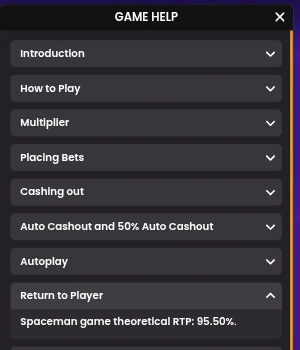
Every slot we have read on this site returns between 96.06% and 96.71%. The whole catalogue fits inside two thirds of a percentage point, which is the point our numbers page is built around. Spaceman sits more than half a point below the bottom of that band.
Two figures on this site do sit lower, and both are Merkur sequels read out of their builds’ own setup data rather than off a help panel: Eye of Horus The Golden Tablet at 95.20% and Fishin’ Frenzy Big Catch at 95.32%. Both are sequels priced below the original they are named after, which is set out on the Merkur profile. Spaceman is not a sequel to anything, which makes 95.50% a starting price rather than a markdown.
Widen it to the genre and the gap grows. Aviator publishes 97%. That is a spread of one and a half percentage points between two crash games, more than double the entire spread of every slot we have read. The format that looks the most uniform from outside, one rising line and one decision, is the one where the price varies most.
The cap is two numbers, and one of them is money
The multiplier starts at 1.00x and stops at 5,000x. The payout cap is stated as whichever of two conditions is reached first: 4,999 to 1, or 500,000 in the game’s own currency units.
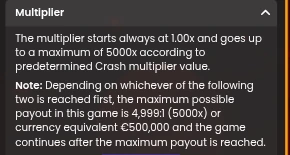
At the stated maximum stake of 100 those two meet exactly, because 100 at 5,000x is 500,000. Below that the multiplier cap is the one that binds and the cash figure never comes into it. So the 5,000x headline is only reachable at the very top of the stake range, which is true of most maximum win figures and almost never said.
The panel also notes that the game continues after the maximum payout is reached. The round does not stop when someone hits the ceiling.
Why the button is worse than the number
This is the part worth the visit, and it is the studio’s own text rather than our inference.
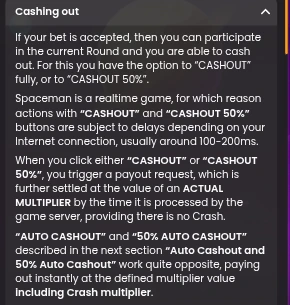
Spaceman is a realtime game, and the help panel says that the manual cashout buttons are “subject to delays depending on your Internet connection, usually around 100-200ms”. When you press one, you trigger a payout request that “is further settled at the value of an ACTUAL MULTIPLIER by the time it is processed by the game server, providing there is no Crash.”
Read that twice. You are not paid at the multiplier you saw when you pressed. You are paid at whatever it has become a fifth of a second later, and if the crash happened inside that window, you are not paid at all.
Auto cashout is then described as working “quite opposite, paying out instantly at the defined multiplier value including Crash multiplier”. Set a number in advance and you get that number.
So the studio has documented, in its own help text, that the reflex-based way of playing its game carries a latency penalty that the automated way does not. Whether the drift helps or hurts on any given round is a coin toss, since the multiplier only ever rises and the risk is the crash landing in the gap. What is not a coin toss is that one method pays exactly what it promises and the other does not.
There is no crash at 5000.00x
A small detail with a nice piece of reasoning behind it. Auto cashout accepts values from 1.01x up to 4999.99x, and the panel explains why the ceiling is not the round 5000.00x: there is no crash at 5000.00x, because reaching it “results in auto payout towards all bets remaining in the game”.
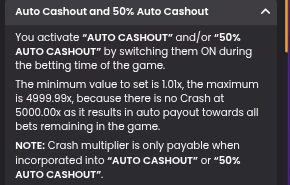
If the astronaut reaches the cap, nobody still in the round loses. Everyone is paid. It is the one outcome in the game where the house stops taking, and it is stated plainly in a collapsed section that most players will never open.
The two cashouts
The controls offer Auto Cashout and a second 50% Auto Cashout, defaulting to 2.00x and 1.50x. Rather than Aviator‘s two independent bets, you place one stake and take half of it out at the lower multiplier while the rest keeps climbing.
The panel states the dependency between them: the 50% value must be lower than the full value, it adjusts itself when you change the full one, and it switches off entirely when the full one is set to 1.01x.
It is a tidier arrangement than running two bets and it makes the common approach the default. It does not change the maths. Half out at 1.50x and half riding to 2.00x returns what the same money returns staked any other way, because every cashout point carries the same expected value. What it buys is a smoother session, which is worth something, just not extra money.
What we would not tell you from this
The bet range in this build reads 1 to 100 in its own currency units. Bet limits on a game like this are set by the operator rather than the studio and vary between casinos, so treat that as what this build offered rather than what you will be given.
There is no volatility rating anywhere in the help panel, and we have not invented one. In a crash game the idea barely applies: the shape of your session is set by the cashout point you choose, not by the game.
Where these numbers come from
The return, the multiplier cap, the cashout behaviour, the auto cashout range and the bet range were all read from Spaceman’s own Game Help panel on 22 August 2026, in the studio’s demo build, framed on this page. Every screenshot above is ours from that session. Nothing here was copied from another listing.
The comparison with Big Bass Crash comes from reading that game’s help panel on the same day. It states 95.50% as well, which is the clearest evidence available that the two games are one set of maths wearing different art.
Common questions
What is the RTP of Spaceman?
95.50%, as stated in the game's own rules panel. That is lower than every slot reviewed on this site and lower than Big Bass Crash, which runs on the same engine and states the same figure. Pragmatic Play publishes no alternative configuration for it.
What is the maximum win on Spaceman?
The multiplier stops at 5,000x. The payout cap is whichever of two limits is reached first: 4,999 to 1 on the stake, or 500,000 in the game's own currency units. At a £100 bet the money cap binds before the multiplier does.
Why does auto cashout stop at 4999.99x and not 5000x?
Because there is no crash at 5000.00x. The rules panel states that reaching the ceiling results in an automatic payout to every player still in the round, so a 5000.00x auto cashout would never have anything to act on. 4999.99x is the highest value the game will accept.
Is manual cashout on Spaceman slower than auto cashout?
Yes, and the game says so. A manual cashout is settled at the multiplier the server has reached when the request arrives, which the help text puts at 100 to 200 milliseconds after the press. An auto cashout pays at exactly the value set. Whether the drift helps or hurts on a given round is a coin toss, but the latency only ever exists on the manual button.
Can I play Spaceman free in the UK?
Yes. The demo on this page loads from Pragmatic Play's own servers when you press play and runs in the UK. It uses play money and its results are not a guide to what happens with real stakes.