 Instant win game review
Spribe
Instant win game review
Spribe
Mines demo and review: the 97% return Spribe never prints
Twenty-five tiles, a mine count you choose, and a return the studio never prints but the game itself gives away.
Spribe publish no return for Mines and the game never states one. Its rules panel prints a maximum of 5044291x, which is exactly 97% of the fair maximum, and the multipliers on the board confirm it twice over.
Play Mines free

Loads from slotslaunch.com when you press play. Nothing is requested from them before that. 18+. Demo play is not a guide to real-money results.
Key facts
| RTP | 97% |
|---|---|
| Max win | x5,044,291 multiplier |
Pros and cons
- The return can be derived exactly from a number the game prints, and it comes to 97%
- No return to player figure appears anywhere in the client, and the advertised 5044291x is capped by the operator to a fraction of itself
On this page
Mines is a 5×5 grid of twenty-five tiles. You choose how many of them hide a mine, from one upward, and then turn tiles over one at a time. Every safe tile raises your multiplier. Every safe tile also raises the chance that the next one ends the round. You may take the money after any pick.
Spribe publish no return to player for Mines. The game does not state one either, and the licensed catalogue leaves the field empty. Every listing we can find either copies a figure from somewhere unnamed or repeats that it is unknown.
It is not unknown. The game prints one number in its rules panel that fixes the return exactly, and the board confirms it in two independent places. The answer is 97%.
The number in the rules panel
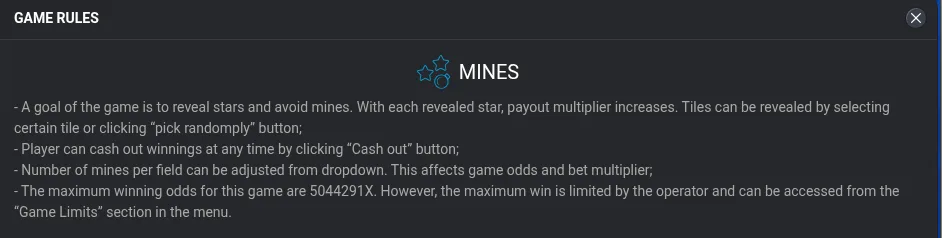
Open the menu, choose Game Rules, and the fourth bullet reads:
“The maximum winning odds for this game are 5044291X. However, the maximum win is limited by the operator and can be accessed from the ‘Game Limits’ section in the menu.”
Five million and change looks like marketing. It is not. It is arithmetic, and it is the arithmetic that gives the game away.
Clearing an entire board is the biggest possible result. With twenty-five tiles and a chosen number of mines, the chance of turning over every safe tile without hitting one is one divided by the number of ways the mines could have been arranged. A game paying that back with no margin at all would pay exactly that many to one.
The most ways mines can be arranged on twenty-five tiles is with twelve or thirteen of them, and that number is 5,200,300. So the largest fair payout Mines could ever offer is 5,200,300x.
5,200,300 x 0.97 = 5,044,291. Not approximately. Exactly, to the unit. The maximum the game advertises is the fair maximum with three percent taken off it, which means Mines is built to a 97% return, the same figure Spribe publish for Aviator and never print anywhere here.
The board agrees
A single coincidence is not evidence, so the next step is to check it against the ladder the game shows you while you play. Before your first pick, Mines prints the multiplier that pick would earn, headed “Next”.
The fair value of the first pick with three mines is twenty-five divided by twenty-two, because twenty-two of the twenty-five tiles are safe. That is 1.136364. Take 3% off and you get 1.102273. The game shows 1.10x, because it cuts the display at two decimals rather than rounding it.
| Mines | Safe picks | Fair multiplier | Less 3% | Game shows |
|---|---|---|---|---|
| 3 | 1 | 1.136364 | 1.102273 | 1.10x |
| 3 | 2 | 1.298701 | 1.259740 | 1.25x |
| 3 | 3 | 1.493506 | 1.448701 | 1.44x |
| 3 | 4 | 1.729323 | 1.677444 | 1.67x |
| 1 | 1 | 1.041667 | 1.010417 | 1.01x |
| 1 | 2 | 1.086957 | 1.054348 | 1.05x |
The three-mine rows are the ones anyone would check first, and they are the ones that will mislead you. Every one of them also fits a slightly smaller margin, because two decimals is not enough resolution to tell 97% from 96.8% at those values. Our own first reading of this game got that wrong.
Setting the dropdown to one mine settles it. At one mine the first pick is fair at 1.041667. Take 3% off and you get 1.01. Take 3.2% off and you get 1.00. The game shows 1.01x, and the second rung lands on 1.05x, which only 97% produces.
The rounding is never in your favour
Cutting the display at two decimals instead of rounding it is a small thing that always points one way. 1.259740 becomes 1.25, not 1.26. 1.448701 becomes 1.44, not 1.45.
So 97% is the design, and what a given rung actually pays is a little under it.
| Safe picks at 3 mines | Paid multiplier | Return on that rung |
|---|---|---|
| 1 | 1.10x | 96.80% |
| 2 | 1.25x | 96.25% |
| 3 | 1.44x | 96.42% |
| 4 | 1.67x | 96.57% |
The differences are small and they are not a strategy. Nobody should pick tiles by hunting for the rung with the least rounding loss, and the effect shrinks as multipliers grow. It is worth stating only because it means 97% is a ceiling on what Mines returns rather than a promise of it.
One mine, one pick, and nothing at all
The 1.01x rung is worth sitting with, because it is where the shape of this game is most visible.
Set the mines to one, stake 0.30 in the demo’s currency, and turn over a single tile. Twenty-four of the twenty-five are safe, so this is about as close to a certainty as a casino game offers. Here is what the client showed.
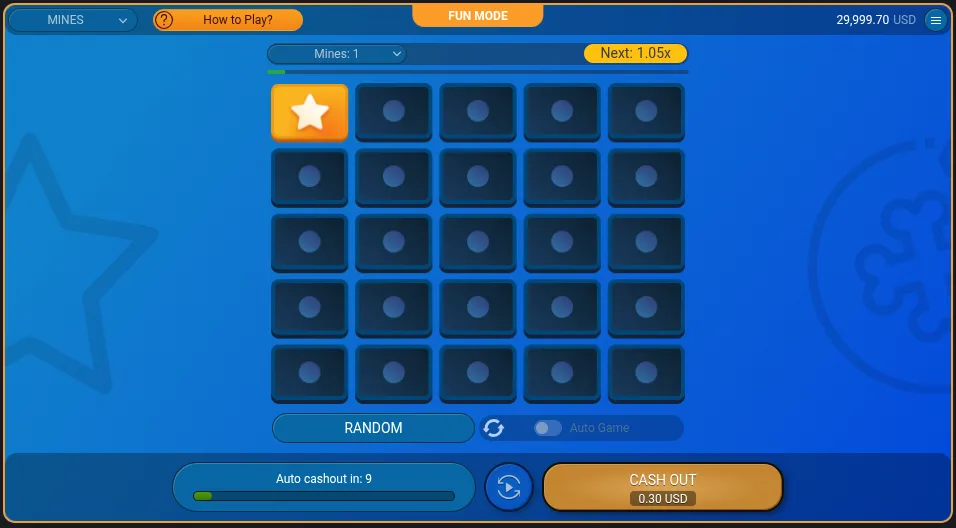
The cash out button offers 0.30. The stake was 0.30. The 1% the multiplier promised is 0.003, and the game settles to two decimal places, so it disappears.
That is the trade in its plainest form: a one in twenty-five chance of losing your stake, in exchange for nothing. It is not a bug and it is not sharp practice. It is what a 97% game looks like when the multiplier is close to one, and it is the reason the game keeps asking you to turn over another tile.
The thirty second timer
The same round showed something else. Sit still with a bet live and the stake panel is replaced by a bar reading “Auto cashout in: 9”, counting down.
Let it run out and the game cashes you out at the multiplier you were on. In the round above, the balance returned to exactly where it started. The limits panel names the timer: thirty seconds.
This is a genuinely player-friendly default and it is unusual enough to note. An idle round in Mines resolves in your favour rather than lapsing.
What the client will tell you, and what it will not
Three panels in the menu could carry a return figure. None of them does.
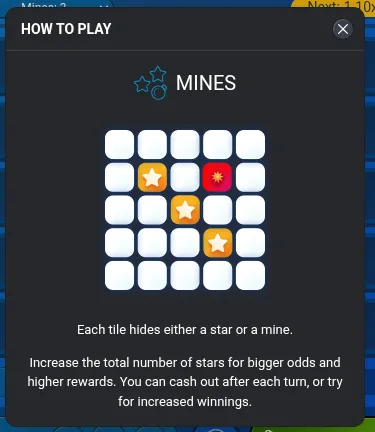
How to Play is two sentences long: “Each tile hides either a star or a mine. Increase the total number of stars for bigger odds and higher rewards. You can cash out after each turn, or try for increased winnings.” That is the entire panel.
Game Rules runs to four sections and holds the 5044291X line, the interface furniture, the auto play instructions and a closing note on malfunctions and dropped connections. No percentage.
Game Limits holds the money.
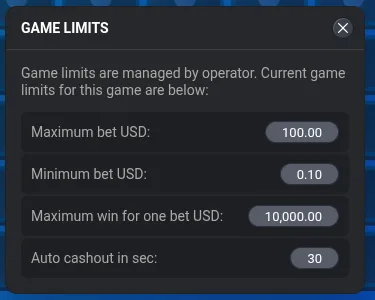
The panel states a minimum of 0.10, a maximum of 100.00 and a maximum win for one bet of 10,000.00, in US dollars. That is roughly 7p, 73 pounds and 7,336 pounds at 0.7336 to the dollar on 25 August 2026. Aviator and JetX state exactly the same three numbers, and JetX is not even a Spribe game, so these are free play defaults rather than anything about Mines. The panel says as much in its own opening line: the limits are managed by the operator.
Two ceilings, and the one that binds
The studio’s ceiling is 5,044,291x. The operator’s ceiling is a cash amount. Whichever is smaller for the stake you are playing is the one that can pay you, and it is almost never the studio’s.
Work it through with the demo’s numbers. A cap of 10,000 on one bet, divided by a 100 stake, allows 100x. Clearing a three-mine board pays 2,231x. At a 100 stake that result is capped at one twenty-second of what the ladder says you won.
You have to drop to a stake of about 4.48 before the full three-mine clear pays out in full, and to reach anywhere near the advertised five million you would need a stake measured in fractions of a penny that no casino accepts.
This is the same trap JetX sets with its 25,000x, and it is the single most useful thing to take away from any of these pages. Ask your casino for its maximum win in pounds and divide by your stake. That number, not the one in the rules panel, is the highest multiplier that can reach your balance.
If your connection drops
The last section of the rules answers this in one line: “If the internet connection is interrupted when the bet is active, the game will auto cash out with the current multiplier, and the winning amount will be added to your balance.”
It is the same rule Aviator carries, and it is the good version. A dropped connection banks what you had rather than voiding it or leaving the round hanging.
The panel adds the standard malfunction clause: if the hardware or software fails, affected bets and payouts are void and the bets refunded.
Provably fair, which answers a different question
Mines is a provably fair game, and the settings panel gives you the working.
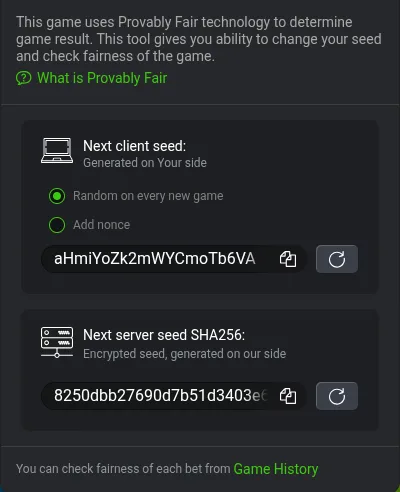
You get a client seed generated on your machine, which you can regenerate or replace with a counter. You get the SHA256 hash of the server’s next seed, published before the round rather than after it. When the seed is revealed you can confirm it hashes to what you were shown, which proves the mine positions were fixed before you touched a tile.
That is a real guarantee and very few casino games offer it. It is also worth being precise about what it covers. It proves the deal was not rigged against you after the fact. It says nothing whatever about the price of the deal, and this client will not tell you that price on any screen.
A game that hands you cryptographic proof of its fairness while declining to state its return has chosen which kind of trust to ask for.
Playing it, in five lines
- The return is 97%, before rounding. The mine count does not change it, and neither does when you stop. More mines means a steeper ladder and a shorter one, at the same price.
- Cashing out early is not safer in the sense people mean. It wins more often and wins less. The rung you take does not change what the game keeps.
- Ask your casino for its maximum win in pounds, then divide by your stake. That is your real ceiling, not the 5044291X in the rules.
- Small multipliers can round away to nothing. At one mine and a small stake, the first pick can pay back exactly what you staked.
- Set your own stopping point before you start a board. There is no rung the game rewards, so the only structure in this game is the one you bring.
Common questions
What is the RTP of Mines?
97%, derived from the game's own maximum winning odds of 5044291X, which is exactly 97% of the fair 5,200,300x for clearing a twelve-mine board. The multipliers on the board confirm it. Spribe do not publish the figure and the game never states it.
Does changing the number of mines change the odds?
It changes the shape and not the price. More mines gives you a steeper ladder with fewer safe tiles behind it; fewer mines gives you a flatter ladder you can walk further along. Every rung of every setting is priced at 97% of fair.
What is the maximum win on Mines?
The game states maximum odds of 5044291X and then says in the same sentence that your operator caps the win. The demo build caps it at 10,000.00 for one bet against a maximum stake of 100.00, which is a hundred times your money. Check the cap in the casino you are playing.
Is Mines rigged?
The provably fair panel lets you check that each board was fixed before you played it, by comparing the revealed server seed against the hash you were shown beforehand. That does not make the game an even bet. It keeps three percent of everything staked whatever you do.
Is there a Mines strategy?
Not one that changes the odds. Where you stop, how many mines you set and which tiles you turn over all leave the expected return where it is. What they change is how often you win and how much when you do.
All figures on this page were read off the running Spribe client on 25 August 2026 and the screenshots show the panels they came from. If you find a casino stating a Mines return, stake range or maximum win different from these, we would like to see it. Corrections and evidence go to [email protected] and get published.