 Crash game review
InOut Games
Crash game review
InOut Games
Chicken Road demo: what InOut states, and the number it leaves blank
Chicken Road states a bet range and a maximum win, and no return to player anywhere in its client. Its lobby carries a heading reading "Chance of collision" with no value under it, which is the one figure that would let you price the ladder.
Play Chicken Road free


Loads from slotslaunch.com when you press play. Nothing is requested from them before that. 18+. Demo play is not a guide to real-money results.
Key facts
| Max win | 1,000,000,000 USD |
|---|---|
| Minimum bet | $0.01 (about £0.01) |
| Maximum bet | $1,000,000 (about £732,280) |
This game states its limits in USD. The sterling figures are a conversion at European Central Bank reference rates of 21 August 2026, not something the game displays.
On this page
Chicken Road is the most searched crash game in Britain right now, and its own client does not tell you what it returns.
That is not a case of the figure sitting somewhere awkward. There are two panels in this game that could carry it. Neither does. The word RTP does not appear in the build at all.
- Not statedRTP
- Not statedVolatility
- 1,000,000,000 USDMax win
- 5.5Our score
Two of those three cells say “not stated” because the game says nothing. The third is a number InOut Games do print, and by the end of this page you will see why it is the least useful figure on the strip.
What the game actually states
Everything Chicken Road says about itself lives in two places. “How to play?” sits on the top bar. “Game rules” is one level down, inside the hamburger menu. Between them they run to about three hundred words.
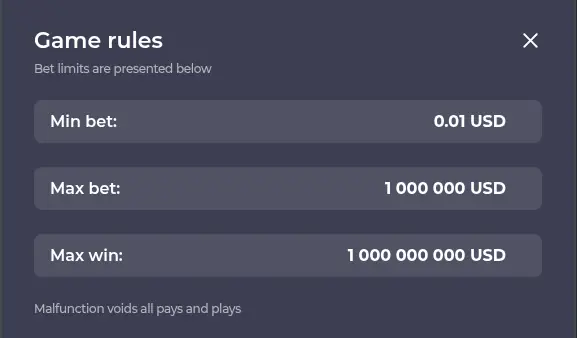
A minimum bet of 0.01, a maximum bet of 1,000,000 and a maximum win of 1,000,000,000, all in US dollars. Then one line of legal text: malfunction voids all pays and plays. That is the whole of it.
Those bet limits are not really facts about Chicken Road. No operator offers a one million dollar stake on a chicken crossing a road. They are the outer walls of the platform the game runs on, set wide enough that whatever limits an actual casino applies will always be the binding ones. Treat them as the range the software permits rather than the range you will meet.
The maximum win is worth one piece of arithmetic, because it is the only figure here that interacts with anything else. A billion dollar cap against a one million dollar maximum stake is a ceiling of 1,000x. Hold that number, because the multiplier ladder is heading straight for it.
The heading with nothing under it
This is the part worth the visit.
Along the bottom of the lobby, to the right of the difficulty selector, Chicken Road prints a heading that reads Chance of collision. It is set in the same style as the “Difficulty” heading opposite it. It looks like a readout.
There is no value under it. Not on Medium, not on Hardcore, not before a round and not with a round in play. It is a label attached to nothing.
The chance of collision is not decoration. In a game built like this one, the chance of surviving a step and the multiplier paid for surviving it are the two halves of the price. Give a player one and they can work out roughly what the game keeps. Give them the multiplier alone and they can work out nothing. Chicken Road shows the multiplier, names the other half in its own interface, and leaves it empty.
We are not suggesting the blank is deliberate concealment. It reads much more like a readout that was designed and never wired up. The effect on a player is the same either way.
The ladder, and how much difficulty changes it
What the game does show you, generously, is the multiplier ladder. It runs across the screen as a row of discs, one per line, and you can read it before staking anything.
The number of lines is set by the difficulty, and “How to play?” states all four.
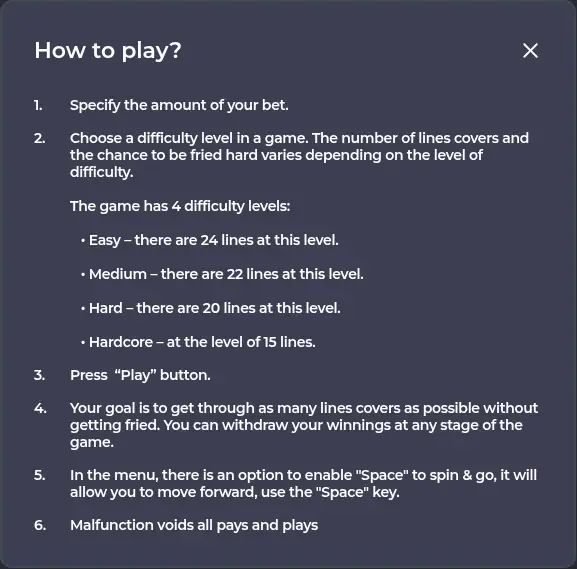
Easy gives you 24 lines, Medium 22, Hard 20 and Hardcore 15. Fewer lines means a shorter road, and the game prices that shorter road very differently.
| Line | Medium, 22 lines | Hardcore, 15 lines |
|---|---|---|
| 1 | 1.12x | 1.63x |
| 2 | 1.28x | 2.80x |
| 3 | 1.47x | 4.95x |
| 4 | 1.70x | 9.08x |
| 5 | 1.98x | 15.21x |
| 6 | 2.33x | 30.12x |
| 7 | 2.76x | 62.96x |
Both columns were read off the board on 23 August 2026. They are the first seven steps of each ladder, and the difference between them is not a matter of degree. Seven lines into Medium you are being offered 2.76 times your stake. Seven lines into Hardcore, the same seven decisions, you are being offered 62.96 times it.

Now put that next to the cap. The gap between consecutive Hardcore steps we read runs between about 1.7 and 2.1 times. A ladder climbing at that rate, with eight lines still to go after the seventh, is not creeping towards a 1,000x ceiling. It is running at it. We did not read the steps past the seventh and make no claim about their exact values, but the direction of travel is not in doubt: on Hardcore, at the top of the stake range, the money cap is a live constraint rather than a remote one.
What you can work out, and what you cannot
You can work out the shape of the bet. Higher difficulty, fewer lines, much steeper rewards, and self-evidently a much greater chance of losing the lot. None of that requires a figure from the studio.
What you cannot work out is the price. Two ladders quoting 1.12x and 1.63x for the identical decision are quoting different odds, and without the survival chance behind each one there is no way to tell which of the two is the better deal, or whether either is good. The comparison people most want to make about this game, which difficulty is the least expensive to play, is exactly the comparison the missing number prevents.
Anyone who tells you Chicken Road’s RTP is 98%, or 97%, or any other specific figure is not reading it off the game, because it is not there to read. They may be quoting an operator’s lobby, a press release or each other. Our guide to the three numbers sets out what a stated RTP does and does not promise, and all of that assumes there is a stated figure in the first place.
Provably fair, and the thing it is not
Chicken Road does carry a provably fair system, and it is properly built. The panel publishes the SHA256 hash of the next server seed before the round, combines it with a client seed that is randomised every game, and invites you to verify any settled bet from your history.
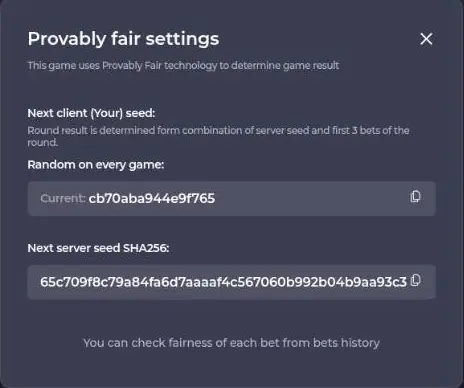
Aviator carries the same kind of badge, and there the point to make was that fairness is not generosity. Here it is sharper than that, because of what is missing.
Provably fair proves the round was not altered after you committed to it. It says nothing whatsoever about the rate at which the game is priced. A game can be perfectly verifiable and still keep fifteen percent of everything staked, and the verification will confirm, round after round, that it kept it honestly. Fairness in this sense is a statement about process, and the number that would tell you about the outcome is the one not on the screen.
There is something almost pointed about the combination. Chicken Road will go to the trouble of publishing a cryptographic commitment so you can audit a single round, while declining to publish the one figure that would let you understand a thousand of them.
Where it sits against the crash games we have read
Three crash games on this site state a return. Aviator publishes 97%. Spaceman states 95.50% in its own help panel, and Big Bass Crash states the same. That is a spread of one and a half percentage points across the format.
Chicken Road cannot be placed in that spread at all. It is not at the bottom of it or the top of it. It is not on the scale, and no amount of reading the game will put it there. You can see the rest of the format on the crash games page.
It is worth being clear that InOut Games are not obliged to publish an RTP, and plenty of games do not. What makes this one worth writing about is the scale of the gap between how much this game is being searched for and how little it discloses.
That gap is what the score on this page is about. Chicken Road is well built: the ladder is visible in advance, the difficulty selector is a real mechanic rather than a reskin, and a one penny minimum is a genuinely low cost of entry. The first thing our rating weighs is whether a game is honest about itself, and on that one it is the weakest game on this site. If you want a crash game whose price you can actually look up, Aviator states 97% and Spaceman states 95.50%, both inside the game where you can check them. We would rather you played one of those.
What to check before you play it
- Check the operator’s lobby for a stated RTP, since the game will not give you one. If the lobby states a figure, that figure is the operator’s claim and not something the game confirms.
- Check which difficulty is selected. It defaults to Medium and it is the single largest thing you control.
- Read the ladder before you stake. It is fully visible in advance, which is more than most formats offer, and it tells you what the game will pay at every line.
- Treat the bet limits in the rules panel as the software’s, not the casino’s. Your actual limits will be much narrower.
- Decide which line you are stopping at before you press play, because the interface is built entirely around the invitation to take one more.
Common questions
What is Chicken Road's RTP?
The game does not state one. We read the entire client on 23 August 2026, including both rules panels and the provably fair settings, and no return to player figure appears anywhere in it. Any specific percentage you see quoted for this game came from somewhere other than the game.
How many lines does Chicken Road have?
It depends on difficulty, and the game states all four: 24 on Easy, 22 on Medium, 20 on Hard and 15 on Hardcore.
Is Chicken Road provably fair?
Yes, and the mechanism is real. The server seed is published as a hash before the round and can be checked afterwards from your bet history. That establishes the round was not tampered with. It does not establish what the game pays out over time.
What is the maximum win on Chicken Road?
The rules panel states 1,000,000,000 USD, against a stated maximum bet of 1,000,000 USD. As a multiple of the largest permitted stake, that is a ceiling of 1,000x.
Is there a strategy for Chicken Road?
Choosing a difficulty and choosing where to stop are genuine decisions, and they change the shape of what happens to you. Neither changes the rate the game is priced at, and without a stated return there is no published rate to reason about in the first place. Be especially wary of anyone selling a system for this game, because the numbers a system would need are not public.
If InOut Games publish a return to player for Chicken Road, or if you find one stated inside a build we have not seen, we would like to know. Corrections go to [email protected] and get published.