 Slot review
Pragmatic Play
Slot review
Pragmatic Play
Big Bass Vegas Double Down Deluxe demo: four RTP figures, and two prices for the same round
This is the most forthcoming game in the Big Bass family. Its rules screen prints four separate return figures, for normal play, the ante bet, the bought round and the bought super round, and all four read 96.50%.
Play Big Bass Vegas Double Down Deluxe free


Loads from demogamesfree.pragmaticplay.net when you press play. Nothing is requested from them before that. 18+. Demo play is not a guide to real-money results.
Key facts
| RTP | 96.50% |
|---|---|
| Volatility | Medium |
| Max win | 5,000x bet |
| Minimum bet | $0.10 (about £0.07) |
| Maximum bet | $375 (about £275) |
| Paylines / ways | 10 |
| Reels | 5 |
| Rows | 3 |
This game states its limits in USD. The sterling figures are a conversion at European Central Bank reference rates of 21 August 2026, not something the game displays.
On this page
Most slot rules screens print one return figure. Some print two. This one prints four, and they are all the same number.
Big Bass Vegas Double Down Deluxe carries a separate stated return for base play, for the ante bet, for the bought free spins round and for the bought super round. Read off the game’s own rules screen on 21 August 2026, in the free demo build, all four read 96.50%. Of the seven games in this family read for this batch, this is the one that prints the most return figures, and the four agreeing with each other is the part worth sitting with.
- 96.50%RTP
- MediumVolatility
- 5,000x betMax win
- 7.0Our score
Four return figures on one screen
The rules run to seven screens. The return figures sit on screen four, alongside a volatility line that reads Medium. That is a slightly awkward place to keep them, far enough in that a reader skimming the first panel will miss them, but they are there, itemised, one line per way of entering the feature.
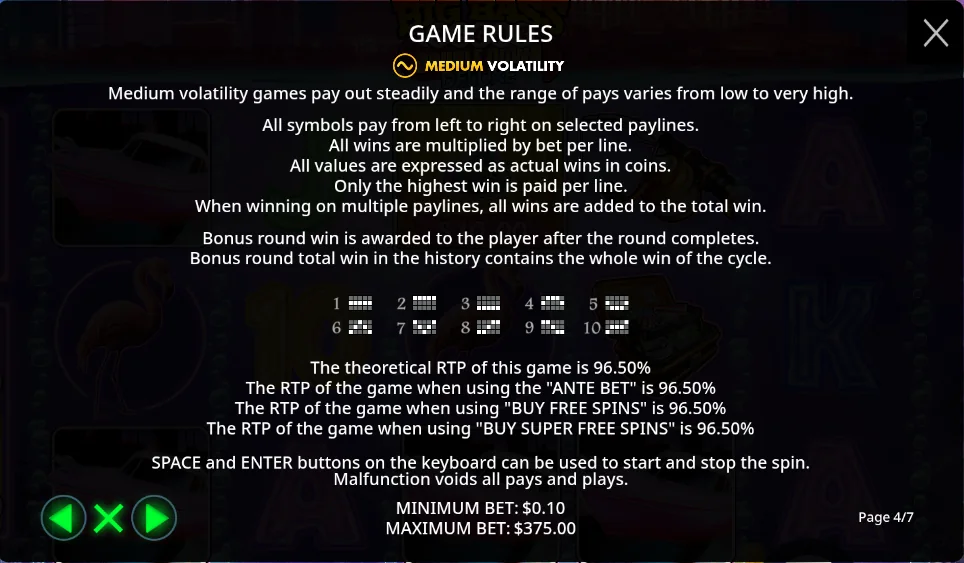
Pragmatic Play’s own game page for this title states 96.50% as well, so the published figure and the printed one agree here. That is not something to take for granted across the range, and it is not the same as the studio publishing all four: the game screen is where the breakdown lives.
Why does an itemised list matter? Because a return figure describes one configuration of a game, not the game as an object. A slot with a purchase option is several configurations sharing a set of reels, and each can be tuned separately. When a rules screen gives you one number, you cannot tell whether it covers the version you are about to buy. Here you can, for every route in.
The base game, and a second fisherman in a different colour
The structure will be familiar to anyone who has opened Big Bass Bonanza or any of the fishing-themed games that followed it. Fish carry cash values. A fisherman wild collects them. Scatters open the free spins round, and inside that round the fisherman is what turns a screen of small fish into a total.
The departure here is in the symbol list. The rules screen describes two wild fisherman symbols rather than one, in different colours, both substituting for everything except the scatter and the money symbols. No other reading in this batch recorded a second wild, but the symbol lists of the other games were not read, so nothing here claims the pairing is unique to this one.
The rules do not spell out, on the screens read, what separates one colour from the other in ordinary play. What they do tell you is that the distinction is tracked. The purchase paragraph refers to wild fishermen “collected in any meter”, which reads to us as more than one counter running at once, one per colour. That is our inference from the wording, not a line the game prints, and it is the first thing we would look at on a build in front of me.
Two prices at the door: 100x and 300x
The purchase panel offers two prices, not one:
- 100x total bet buys the free spins feature, with at least three scatters guaranteed on the triggering spin.
- 300x total bet buys the super free spins feature, on the same guarantee of at least three scatters.
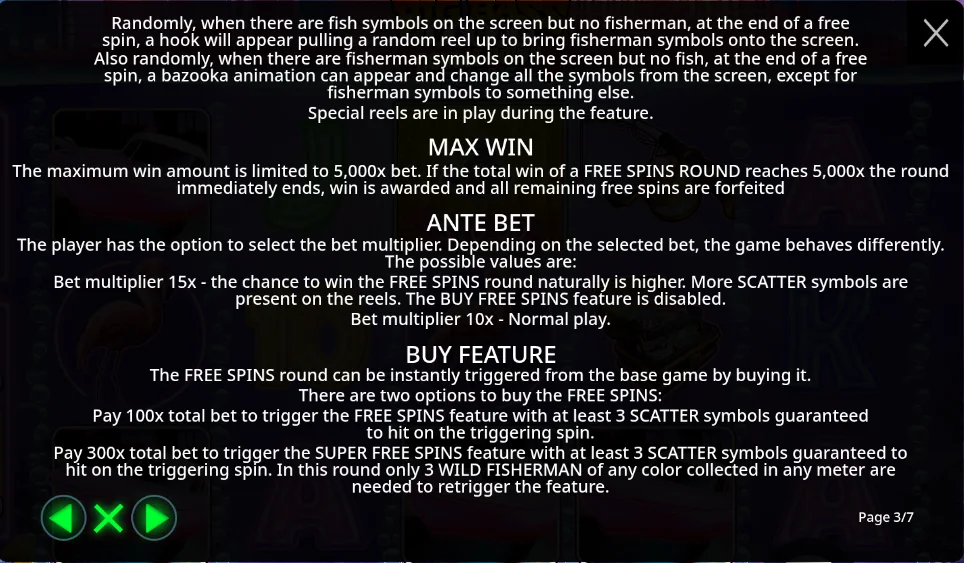
Bet limits were read as 0.10 minimum and 375.00 maximum. Working those against the two prices is our arithmetic rather than anything the screen prints: at the smallest stake the two doors cost 10.00 and 30.00, and at the largest, 37,500.00 and 112,500.00.
What the 300x version changes
One sentence in the purchase paragraph carries the whole difference. In the super round, “only 3 WILD FISHERMAN of any colour collected in any meter are needed to retrigger the feature”.
That is the only retrigger condition the screens read here print: in the super round, three wild fishermen of any colour, counted across the meters rather than within one. What the ordinary round asks for is not stated on any of the seven screens, so how far the super round relaxes it is not something this page can size. The retrigger is the mechanism that lets a round keep going rather than end, so relaxing it changes how long the round can run, not how much any single fish is worth.
Set that against the return figures and the shape becomes clear. The bought round and the bought super round both state 96.50%. Paying three times as much does not buy a better stated return. It buys a different distribution: a round whose retrigger condition the rules state separately, with the same figure printed over the top of it. Whether the shape of the round suits you is a separate question from what it returns, and the game is unusually clear about keeping those two questions apart.
The ante bet takes the buy button away
The ante line is worded plainly. A bet multiplier of 15x “gives a higher natural chance of the free spins round and more scatters on the reels, and disables BUY FREE SPINS”. A bet multiplier of 10x is normal play.
So the two routes are mutually exclusive by design. You are either paying a raised stake every spin for better scatter frequency, or you are paying a lump sum for a guaranteed entry, and the game will not let you do both on the same spin. Comparing the two multipliers is our arithmetic: 15 against 10 means the ante costs half again per spin. The stated return for that mode is 96.50%, the same as normal play, so the ante here is buying frequency rather than trading return for it. That is not universal in the family. Big Bass Day at the Races prints an ante figure a hundredth below its base figure, which is a different bargain even though it looks like the same button.
What four matching numbers do and do not tell you
Four identical figures are easy to misread as four identical experiences. They are not. A stated return is a long-run average for one configuration; it says nothing about how that average is reached, how often the round arrives, or how far a single round can travel. The volatility line, read as Medium, is a separate label set by the studio, and this site’s guide to RTP, volatility and max win covers why those two lines answer different questions.
What the four figures do give you is the ability to check a decision instead of guessing at it. If the super buy had been tuned down a point, you would see it on screen four. It is not, so the extra 200x is buying the retrigger condition and nothing else that the game admits to.
A 5,000x ceiling with a stop sentence attached
The cap read as 5,000x bet, and the wording explains what happens when it is reached: “If the total win of a FREE SPINS ROUND reaches 5,000x the round immediately ends, win is awarded and all remaining free spins are forfeited.”
That sentence matters in a round written to keep going. The super round’s whole proposition is that it can keep going. The cap is the line where keeping going stops mattering, because the round ends there whether or not spins remain on the counter. Converting the two figures is our arithmetic again: at the 0.10 minimum the ceiling is 500.00, and the super buy at 300x is 30.00, so the cap sits at a little under seventeen times the price of the more expensive entry.
Placing 96.50% among the seven readings
Six of the seven games in this family were read on 21 August 2026, Big Bass Bonanza on 19 August, and 96.50% sits between the two clusters the others fall into: a 96.71% group and a 96.0x group. The three highest returns read are joint, at 96.71%, on Big Bass Bonanza, Big Bass Christmas Bash and Big Bass Splash. The lowest read is Big Bass Halloween at 96.06%. This game is below the first and above the second.
The ceiling ranks differently again. 5,000x is not the largest read in the family, and the largest returns do not come with the largest ceilings. The full seven-game comparison, laid out figure by figure, lives on the Big Bass Halloween review, which is the right place to read the family side by side rather than one game at a time.
One caveat carried from that table: Big Bass Bonanza’s ante and buy lines were never read, so nothing here claims anything about them.
Check screen four before you check anything else
Operators can run different configurations, and a demo build is not a promise about the version a given site serves. Screen four is where this build keeps its return figures, so start there and count the lines. Four of them, all reading the same number, is what was read here on 21 August 2026. Three lines, or four that disagree, and the page you are reading now is describing a different configuration from the one you have open.
The buy panel comes next, because it is the part of this game a reader is most likely to act on. Both prices should be there, 100x and 300x, and the 300x line should name the super feature rather than repeat the first. Inside that same paragraph, look for the words “3 WILD FISHERMAN of any colour”. If your build words the retrigger differently, the extra 200x is buying something other than what is described above.
The stake range is the last thing to look at and the one most likely to have been altered: 0.10 to 375.00 was read here. It sets what every multiple on this page is actually worth, the two buy prices and the 5,000x ceiling alike, so a narrowed range quietly rewrites all of them in money terms.
That is a minute or two of reading, and it is the only way to know that the figures on this page describe the game you have opened. 18+ only, and the demo build exists so that none of this checking costs anything.
Common questions
If every figure is 96.50%, is the 300x buy worth three times the 100x?
The stated return does not answer that, and the game does not claim it does. Both bought rounds print 96.50%. What the higher price changes is the retrigger condition, stated for the super round as three wild fishermen of any colour collected in any meter, which affects how long a round can run rather than what it returns on average. The ordinary round's condition is not printed on the screens read here, so the distance between the two is not something this page can put a size on. It is a choice about the shape of the round, at three times the entry cost.
Does the 5,000x limit apply outside the free spins round?
The cap is stated as a limit on the maximum win amount, and the sentence explaining how it triggers is written specifically around a free spins round ending early. The screens read here do not spell out equivalent wording for base play. That is a genuine gap rather than a reassurance, and it is worth rereading on your own build.
Where does the second fisherman colour matter?
The only place the screens read make the colours load-bearing is the super round's retrigger, where colour stops mattering. Both wilds substitute for everything except scatter and money, so in ordinary play they behave alike as far as the rules screen says. If the colours drive separate collection meters, that is implied by the phrase "in any meter" rather than stated outright, and my reading of it is an inference, not a printed line.